Revision to Delaware’s
State Implementation Plan
To Sunset the Requirements of 7 DE Admin. Code 1139, and Demonstrate the Requirements of 40 CFR 51.121 Continue to be Met
June 12, 2013 Proposal
1.0 Introduction
A State Implementation Plan (“SIP”) is a state plan that identifies how that state will attain and maintain air quality that conforms to each primary and secondary National Ambient Air Quality Standard (”NAAQS”). The SIP is a complex, fluid document containing regulations, source-specific requirements, and non-regulatory items such as plans and emission inventories.
Delaware’s initial SIP was approved by the US Environmental Protection Agency (EPA) on May 31, 1972. Since this initial approval the Delaware SIP has been revised numerous times to address air quality non-attainment and maintenance issues. The revisions consisted of updated plans and inventories, and new and revised regulatory control requirements. Delaware’s SIP is compiled at 40 C.F.R. Part 52 Subpart I.
2.0 Background
Ground-level ozone is a pollutant formed when nitrogen oxides (NOx) and volatile organic compounds (VOC) react in heat and sunlight. Ozone is an air pollutant that causes respiratory illness, eye irritation, and plant damage.
The primary reason many mid-Atlantic and north-east States, including Delaware, have unhealthy air quality relative to the pollutant ozone is because ozone and its precursors, VOC and NOx, are transported into the region from upwind areas. Because of the pollution transport problem, a group was formed to perform a study of the ozone transport problem and to propose efficient and cost-effective solutions. This group was the Ozone Transport Assessment Group (OTAG) and was comprised of representatives of the USEPA, the Environmental Council of States (ECOS), and various industry and environmental groups. The OTAG study found that the principal contributor to the ozone transport problem is transport of NOx emissions.
Based on the findings of the OTAG study, in the November 7, 1997 Federal Register (62 FR 60318) the USEPA proposed a finding that NOx emissions from sources and activities in 23 jurisdictions (including Delaware) significantly contribute to non-attainment of the 1-hour and 1997 8-hour ozone NAAQS, or will interfere with the maintenance of the 1997 8-hour NAAQS, in one or more downwind states. In the September 24, 1998 Federal Register (63 FR 57396), the EPA finalized its rule “Finding of Significant Contribution and Rulemaking for Certain States in the Ozone Transport Assessment Group Region for Purposes of Reducing Regional Transport of Ozone.” This rule, along with later technical amendments, is commonly referred to as the NOx SIP Call. The purpose of the NOx SIP Call was to require the subject jurisdictions to reduce NOx emissions, thereby reducing NOx transport into downwind non-attainment areas.
A March 3, 2000 ruling of the D.C. Circuit Court of Appeals had the effect of eliminating three states from the original group of jurisdictions identified in the NOx SIP call. The final group of jurisdictions subject to the NOx SIP Call after the court ruling include Alabama, Connecticut, Delaware, District of Columbia, Illinois, Indiana, Kentucky, Massachusetts, Maryland, Michigan, North Carolina, New Jersey, New York, Ohio, Pennsylvania, Rhode Island, South Carolina, Tennessee, Virginia, and West Virginia.
The NOx SIP Call required the affected jurisdictions, including Delaware, to adopt and submit SIP revisions requiring sources in the jurisdiction to reduce NOx emissions sufficiently to eliminate the amount of NOx emissions that contribute significantly to non-attainment in, or interfere with maintenance by, a downwind state. It was EPA’s position that by eliminating those amounts of NOx emissions, the control measures would assure that remaining NOx emissions would meet jurisdiction-specific ozone season NOx emissions budgets, as specified in the NOx SIP Call (40 CFR 51.121(e)(2)(i)).
Each jurisdiction’s ozone season NOx emissions budget was determined based on forecasted base-2007 jurisdiction-wide ozone season NOx inventories. The USEPA applied growth factors to baseline emission inventories for the source sectors of electric generating units (EGU), non-EGU point sources, stationary area sources, on-road mobile sources, and off-road mobile sources to calculate the base-2007 inventories. These base-2007 inventories also reflected then-existing controls and controls required to be implemented by 2007. For the stationary area, on-road-mobile, and off-road mobile source sectors, the base-2007 inventories became the 2007 budgets because the USEPA applied no additional controls to the sectors in deriving the 2007 budgets.
Point source sectors were handled differently, in that for the EGU and non-EGU point source sectors the 2007 budgets were derived from the base-2007 inventory by applying additional controls to those sectors. This was done by assuming an EGU NOx control level of 0.15 lb/MMBTU emission rate on units with a nameplate rating of 25 MW or greater, and by assuming a non-EGU NOx emissions control of 60% from uncontrolled levels for boilers and combustion turbines with heat input ratings of 250 MMTU/hr or greater.
The procedures for deriving the base and budget values were described in the USEPA document “Development of Emission Budget Inventories for Regional Transport NOx SIP Call Technical Amendment Version” (A-96-56:X-B-11), December, 1999. The USEPA revised the baseline and budget numbers several times and released the final values in the April 3, 2000 rule “Technical Amendment to the Finding of Significant Contribution and Rulemaking for Certain States for the Purposes of Reducing Regional Transport of Ozone.”
Delaware’s overall ozone season NOx budget was identified in 40 CFR 51.121(e)(2)(i) as 22,862 tons/season. 40 CFR 51.121(g)(2)(ii) identified Delaware’s related ozone season NOx budget sub-inventories as follows: EGU sector as 5,250 tons of NOx, the non-EGU sector as 2,473 tons of NOx, the area source sector as 1,129 tons of NOx, the non-road sector as 5,651 tons of NOx, and the on-road sector as 8,358 tons of NOx.
The NOx SIP Call did not require NOx reductions from specific sources, but rather set overall jurisdiction ozone season NOx mass emissions budgets for each of the affected jurisdictions as documented in 40 CFR Part 51.121(e). Each jurisdiction had the option to choose to reduce ozone season NOx emissions from point sources, stationary area sources, on-road mobile sources, and/or off-road mobile sources. Jurisdictions were also afforded compliance flexibility through 40 CFR 51.121(b)(2): “The requirements of paragraph (b)(1)(i) of this section shall be deemed satisfied, for the portion of the budget covered by an interstate trading program….” Through 40 CFR Part 96, the USEPA established a market-based interstate NOx emissions trading program to facilitate meeting the requirements of 40 CFR 51.121(b).
3.0 Delaware’s NOx SIP Call Compliance Action
In compliance with the requirements of 40 CFR 51.121, in August 2000 Delaware submitted to the USEPA as a SIP revision, “Delaware Plan for Meeting the Nitrogen Oxide (NOx) Budget Requirements Contained in the EPA NOx SIP Call.” In this document, Delaware indicated that it accepted the USEPA’s ozone season NOx emissions budget values for each Delaware source sector, and also indicated it would promulgate and implement a regulation to facilitate participation of Delaware EGU and non-EGU point sources in the EPA’s interstate emissions trading program. This regulation was promulgated as Regulation 39, Nitrogen Oxides (NOx) Budget Trading Program, in December 2000 (Regulation 39 was later re-numbered to 7 DE Admin. Code 1139 for administrative purposes with no substantive changes, and will be referred to as 7 DE Admin. Code 1139 throughout this document). The participation of Delaware’s EGU and non-EGU source sectors in the EPA’s 40 CFR Part 96 interstate NOx emissions trading program met the NOx SIP Call requirements for those source sectors in accordance with 40 CFR 51.121(b)(2). The 40 CFR 51(g)(2)(ii) NOx budget for these two Delaware source sectors totaled 7,723 tons/season.
7 DE Admin. Code 1139 held each of Delaware’s EGUs with a nameplate capacity rating of 25 MW or greater to an allocation that was determined by multiplying each unit’s base heat input by a NOx emissions factor of 0.15 lb/MMBTU. Each non-EGU with a maximum design heat input capacity of 250 MMBTU/hr or greater was held to an allocation that was determined by multiplying each unit’s base heat input by a NOx emissions rate factor of 0.17 lb/MMBTU. This methodology was that recommended in USEPA’s NOx Budget Trading Program model rule (40 CFR Part 96).
In addition, 7 DE Admin. Code 1139 went beyond the requirements of the NOx SIP Call by requiring that every EGU and process heater with a design capacity between 15 MW and 25 MW be held to an allocation based on historic operation. That allocation was determined by multiplying each unit’s base heat input by the unit’s actual average 1996 ozone season NOx emissions rate. Allocations under 7 DE Admin. Code 1139 totaled 5,227 NOx emissions allowances per ozone season.
4.0 NOx SIP Call Emission Trading Program Transition to CAIR
On May 12, 2005, the USEPA published its final rule entitled “Rule to Reduce Interstate Transport of Fine Particulate Matter and Ozone (Clean Air Interstate Rule); Revisions to Acid Rain Program; Revisions to NOx SIP Call” (70 FR 25162). This rule and subsequent amendments are commonly referred to as CAIR. In part CAIR requires affected jurisdictions to reduce NOx emissions that contribute significantly to non-attainment and maintenance problems in downwind jurisdictions with respect to the national ambient air quality standards for 8-hour ozone. Among other things, CAIR established a model ozone season NOx emissions cap-and-trade program as a control option for states to choose as a possible compliance option for CAIR’s ozone season NOx emissions requirements. This portion of CAIR is similar to the ozone season NOx SIP Call Budget Trading Program.
On April 28, 2006 the USEPA published federal implementation plans (FIPs) for CAIR as part of a final rule entitled “Rulemaking on Section 126 Petition From North Carolina to Reduce Interstate Transport of Fine Particulate Matter and Ozone; Federal Implementation Plans to Reduce Interstate Transport of Fine Particulate Matter and Ozone; Revisions to the Clean Air Interstate Rule; Revisions to the Acid Rain Program” (71 FR 25328). The USEPA indicated that the CAIR FIPs would be implemented to achieve attainment of air quality standards when a jurisdiction does not or is unable to develop an adequate state implementation program. As its control strategy, the CAIR FIPs adopted the model cap-and-trade programs (including the ozone season NOx emission cap-and-trade program) that were provided in CAIR, with the exception that USEPA would implement and administer the programs rather than the subject jurisdiction. The FIPs require EGUs in subject jurisdictions to participate in the appropriate emissions cap-and-trade programs, which for Delaware included the CAIR ozone season NOx cap-and-trade program. As opposed to establishing a state run compliance strategy, Delaware decided to accept a full federal FIP with the USEPA administering the program for Delaware. Therefore, Delaware’s EGU point sources that were subject to the NOx SIP Call Budget Trading program then became subject to the requirements of the USEPA CAIR FIP Ozone Season NOx Trading Program administered by the USEPA.
As indicated above, under a full federal FIP, only EGUs in subject jurisdictions are required to participate in the USEPA administered ozone season NOx cap-and-trade program. (One exception to this general rule for Delaware was EPA’s inclusion of the Delaware City Refinery unit DCPP4 in the CAIR annual and ozone season NOx cap-and-trade programs. For this reason the Delaware City Refinery unit DCPP4 is considered to be an “EGU” meeting the applicable CAIR requirements for the purposes of this evaluation.) Of the 35 units that 7 DE Admin. Code 1139 required to participate in the NOx SIP Call Budget Trading Program, the FIP only required and facilitated 21 of those units to participate in the FIP’s CAIR ozone season NOx cap-and-trade program. Under the CAIR FIP, these units are required to monitor and report NOx ozone season emissions and hold allowances sufficient to balance actual NOx emissions in accordance with the requirements of the CAIR FIP ozone season NOx trading program. The following table lists the 22 units that were subject to 7 DE Admin. Code 1139 and subsequently are subject to the CAIR ozone season NOx trading program under the CAIR FIP:

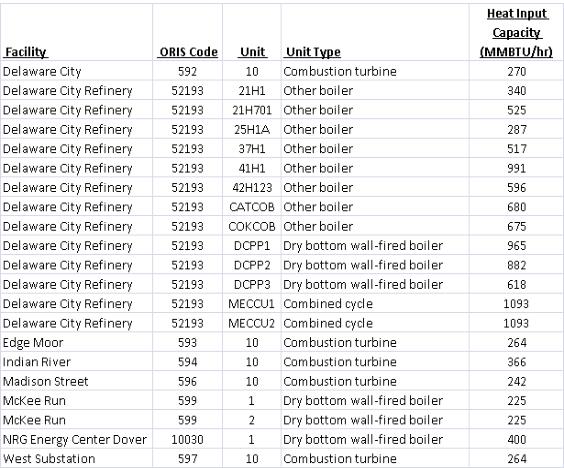
Under the EPA’s CAIR FIP, Delaware’s non-EGUs (co-generation units, large process boilers and heaters, and EGUs with nameplate capacities 15 MW or greater but less than 25 MW) were not included in the CAIR FIP ozone season NOx trading program. The following table lists the 21 units that were subject to Delaware’s 7 DE Admin. Code 1139 and subsequently not subject to the CAIR ozone season NOx trading program under the CAIR FIP:
5.0 Delaware NOx Controls Applicable to NOx SIP Call Non-EGUs
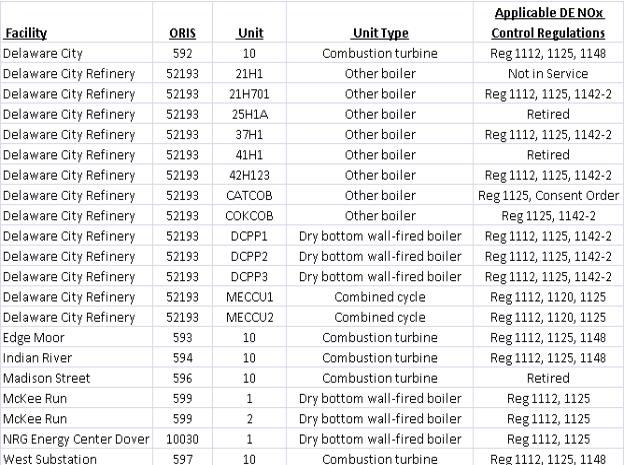
The non-EGUs that were allocated NOx SIP Call Budget Trading Program allowances under Delaware’s 7 DE Admin. Code 1139 and that did not transition to the CAIR FIP NOx Ozone Season Trading Program include boilers and combustion turbines that are connected to electric generators that have nameplate rating of 15MW or greater but less than 25 MW, and co-generation units, process heaters and boilers that have heat input ratings of 250 MMBTU/hr or greater. In addition to the requirement of Delaware’s 7 DE Admin. Code 1139 to participate in the SIP Call’s NOx Budget Trading Program, these units’ NOx emissions are controlled by other applicable State of Delaware air emissions regulations. Delaware’s NOx emissions regulations that continue to be applicable to these non-EGU sources include the following:
|
•
|
7 DE Admin. Code 1112, Control of Nitrogen Oxides Emissions: This regulation was promulgated in 1993, and its NOx emissions rate limitations became effective in May, 1995. This regulation is applicable to major stationary NOx sources in Delaware, including fuel burning sources. 7 DE Admin. Code 1112 prohibits NOx emissions in excess of those obtainable incorporating reasonably available control technology (RACT). 7 DE Admin. Code 1112 requires NOx emissions to be monitored using the provisions of 40 CFR Part 60.
|
|
•
|
7 DE Admin. Code 1142, Specific Emission Control Requirements, Section 1, Control of NOx Emissions from Industrial Boilers: This regulation was promulgated in 2001, and its NOx emissions rate limitations became effective in May, 2004. 7 DE Admin. Code 1142, Section 1 is applicable to any combustion unit with a heat input rating of 100 MMBTU/hr or greater that did not attain the presumptive NOx RACT emission rate of Table 3.1 of Delaware’s 7 DE Admin. Code 1112 and also did not install specific NOx controls. 7 DE Admin. Code 1142, Section 1, effectively regulated sources that remained high NOx emitters after the application of NOx RACT and post-RACT requirements and that had not committed substantial capital funds to reduce NOx emissions. 7 DE Admin. Code 1142 requires NOx emissions to be monitored using the provisions of 40 CFR Part 60.
|
|
•
|
7 DE Admin. Code 1142, Specific Emissions Control Requirements, Section 2, Control of NOx Emissions from Industrial Boilers and Process Heaters at Petroleum Refineries: This regulation was promulgated in July, 2007, and revised in April, 2011. 7 DE Admin. Code 1142, Section 2 is applicable to industrial boilers and process heaters located within a petroleum refinery facility that have a heat input rating of 200 MMBTU/hr or greater. The regulation establishes very low NOx emissions rate limits for subject units, or a low overall NOx mass emission cap, and requires NOx emissions to be monitored using the provisions of 40 CFR Part 60.
|
|
•
|
7 DE Admin. Code, Control of Stationary Combustion Turbine Electric Generating Unit Emission: 7 DE Admin. Code 1148 was promulgated in 2007 and its NOx emissions rate limitations became effective in May, 2009. This regulation is applicable to existing stationary combustion turbine electric generating units in Delaware with a nameplate rating of 1 MW or greater. 7 DE Admin. Code 1148 requires subject units (that were otherwise exempt from attaining RACT NOx emissions limitations of 7 DE Admin. Code 1112 due to very low operating capacity factors) to emit NOx at a rate no higher than presumptive RACT levels or install NOx emission controls designed to attain the regulation’s NOx emission rate limits. (Note: all combustion turbine EGUs subject to 7 DE Admin. Code 1148 have installed water injection for NOx control in response to the requirements of this regulation and operated those controls beginning with the 2009 ozone season for compliance with 7 DE Admin. Code 1148.)
|
The above referenced Delaware NOx control regulations are applicable to the individual Delaware NOx SIP Call units not transitioning to the CAIR FIP ozone season NOx trading program as shown in the following table:
6.0 Current Emissions from NOx SIP Call Non-EGUs
Delaware’s regulatory NOx controls have helped Delaware achieve significant ozone season NOx emissions reductions from this group of NOx SIP Call non-EGU sources. In order to fully assess the effect of Delaware’s NOx emissions control requirements on the NOx SIP Call non-EGU sources, an estimate was performed for the ozone season NOx emissions potential to emit (PTE) for this group of sources. For this estimation, the EPA’s Air Monitoring Program Data (AMPD) database was accessed for the individual Delaware NOx SIP Call non-EGUs to obtain representative ozone season NOx mass emissions and hours of operation. The individual Delaware NOx SIP Call non-EGU’s ozone season hourly NOx emissions rate was determined by dividing the AMPD’s ozone season NOx mass emissions by the AMPD’s ozone season hours of operation. Each individual Delaware NOx SIP Call non-EGU’s ozone season potential to emit was then calculated by multiplying that source’s ozone season hourly NOx emissions rate by 3,672 hours per ozone season. The individual Delaware NOx SIP Call non-EGU ozone season potential to emit values were then added together to obtain a total Delaware NOx SIP Call non-EGU fleet ozone season NOx emissions potential to emit. The resulting Delaware NOx SIP Call non-EGU fleet ozone season NOx potential to emit was estimated to 1,702 tons of NOx per ozone season.
It should be noted that the value estimated above for the Delaware NOx SIP Call non-EGU sources is a very conservative value. Six of the sources included in the estimate are small electric generating units that serve a “peaking” function and historically operate only a few hours per ozone season. For the ozone seasons during the period of 2007 through 2012 the operating hours per ozone season for these non-EGU sources ranged from a high of 163 hours to less than 2 hours, with an overall average of 36 hours per ozone season. Therefore, a PTE calculation that includes 100% operating capacity factor for those sources greatly overestimates the realistically expected NOx emissions from those units individually and as a group.
Regardless, the estimated ozone season NOx mass PTE for the Delaware NOx SIP Call non-EGU provides a value significantly lower than the EPA’s NOx SIP Call non-EGU source sector 2007 NOx budget of 2,473 tons per season, as identified in 40 CFR 51.121(g)(2)(ii). This provides a clear indication that Delaware’s NOx emissions regulations have effectively served to control the NOx emissions from Delaware’s NOx SIP Call non-EGU sources.
7.0 Delaware EGU and non-EGU NOx Emissions Post-NOx SIP Call
While Delaware promulgated its regulation 7 DE Admin. Code 1139 to implement the EPA’s NOx SIP Call NOx cap-and-trade program model rule for compliance with the NOx SIP Call’s NOx mass emissions caps for EGUs and other large boilers and combustion turbines, Delaware also determined that it was appropriate to address the NOx emissions rates of these same units. As a result, existing Delaware regulations that addressed EGU NOx emissions were supplemented with additional regulations in order to fully address the Delaware’s fleet of EGUs, both existing and new EGUs. This group of regulations include the following:
|
•
|
7 DE Admin. Code 1112, Control of Nitrogen Oxides Emissions, effective November 1993: This regulation established NOx emission rate limits for major sources of NOx emissions, including boilers and combustion turbines used to power EGUs.
|
|
•
|
7 DE Admin. Code 1120, New Source Performance Standards, effective December 1988: This regulation includes NOx emission rate limits for new fuel burning units with a rated heat input capacity of 250 MMBTU/hr or greater.
|
|
•
|
7 DE Admin. Code 1125, Requirements for Preconstruction Review, effective August 2005: This regulation includes requirements for preconstruction review of proposed new sources of NOx emissions, and includes requirements of prevention of significant deterioration (PSD) and emissions offset provisions (EOP). These requirements also include provisions for selection of best available control technology (BACT) and lowest achievable emission rate (LAER) for NOx emission sources.
|
|
•
|
7 DE Admin. Code 1136, Acid Rain Program, effective September 1996: This regulation adopted by reference the requirements of Parts 72 through 78, of Title 40 of the Code of Federal Regulations.
|
|
•
|
7 DE Admin. Code 1146, Electric Generating Unit (EGU) Multi-Pollutant Regulation, effective 2006: This regulation established NOx emission rate limits and annual NOx mass emission limits for coal-fired and residual fuel oil-fired EGUs with nameplate ratings of 25MW or greater. The regulation established a NOx emissions rate limit of 0.15 lb/MMBTU beginning with the ozone season in 2009, and established a NOx emissions rate limit of 0.125 lb/MMBTU beginning in January 2012. Both the 0.15 lb/MMBTU NOx emission rate limit and the 0.125 lb/MMBTU NOx emission rate limit are based on a rolling 24-hr compliance period.
|
|
•
|
7 DE Admin. Code 1148 Control of Stationary Combustion Turbine Electric Generating Unit Emissions, effective 2007: This regulation established NOx emission rate limits (and presumptive control requirements) for combustion turbines with a nameplate rating of 1MW or greater, except: 1) existing stationary combustion turbine electric generating units that are subject to 7 DE Admin. Code 1112 and meet the NO x emissions limitations identified in Table 3-2 of 7 DE Admin. Code 1112, and are not otherwise exempt from the NO x emissions limitations of Table 3-2 of 7 DE Admin. Code 1112, or; 2) existing stationary combustion turbine electric generating units that have undergone New Source Review in accordance with 7 DE Admin. Code 1125 and are covered by a permit which imposes NO x emissions limitations established to meet Best Available Control Technology or Lowest Achievable Emission Rate technology standards.
|
Delaware’s regulations concerning NOx emissions from EGUs, and related consent decrees, have effectively required Delaware’s fleet of EGUs to be well controlled from a NOx emissions standpoint. Delaware’s requirements have resulted in the addition of effective NOx controls and/or modifications to existing EGUs to reduce NOx emission rates. Delaware’s regulations also require any new EGU in Delaware to be well controlled, requiring start-of-the-art controls to meet NOx emissions limitations. A summary of the NOx emissions controls installed on Delaware’s EGUs is shown in the following table:
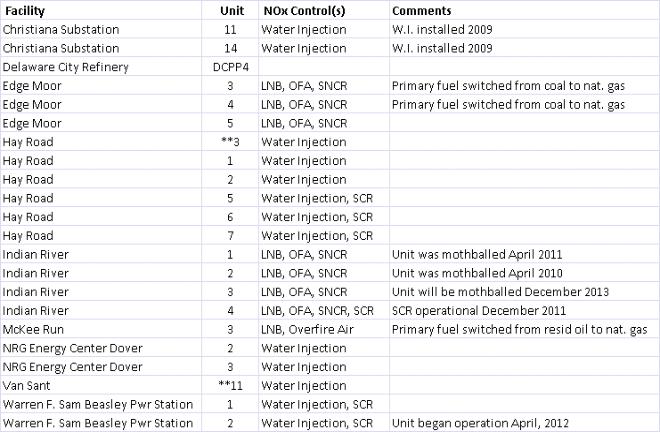
As noted earlier in this document, the Delaware City Refinery unit DCPP4 is categorized as an EGU for the purposes of this document since the EPA has included DCPP4 in the CAIR annual and ozone season NOx cap-and-trade programs. However, the Delaware City Refinery DCPP4 is a refinery boiler, and this source is subject to all of Delaware’s NOx emissions regulations specified for non-EGUs in this document, including 7 DE Admin. Code 1112, Control of Nitrogen Oxides Emissions, and 7 DE Admin. Code 1142, Specific Emissions Control Requirements, Section 2, Control of NOx Emissions from Industrial Boilers and Process Heaters at Petroleum Refineries.
The addition of NOx emissions rate controls to Delaware’s EGUs have resulted in significant reductions in ozone season NOx mass emissions from those Delaware EGUs. The following graph exhibits data from the EPA’s Air Markets Program Data (AMPD) database, and shows the ozone season NOx emissions from Delaware’s EGUs for the period of 2007 through 2012:

The EPA’s AMPD information depicted in the above graph indicates that between the 2007 ozone season and the 2012 ozone season there was a reduction of approximately 3,262 tons of NOx emissions (an approximate 77% reduction) from DE’s fleet of EGUs. The Delaware EGU NOx emissions of the 2012 ozone season, which was first ozone season to reflect full implementation of Delaware EGU NOx control regulations, also represents a NOx emissions reduction of 4,259 tons of NOx below the Delaware NOx SIP Call ozone season EGU NOx allowance allocation of 5,250 tons of NOx per ozone season, as identified in 40 CFR 51.121(g)(2)(ii). This represents an approximate 81% reduction below the allocation level. Further, the Delaware EGU 2012 ozone season NOx emissions represent a seasonal NOx emissions reduction of 4,847 tons below the NOx SIP Call’s 2007 base NOx emissions for the Delaware EGUs of 5,838 tons of NOx per ozone season (representing an approximate reduction of 83% below the base level). The NOx SIP Call ozone season NOx emissions allocation for Delaware’s EGUs reflected a required reduction of 588 tons per season below the 2007 base value whereas the actual 2012 ozone season Delaware EGU NOx emissions were more than 8 times that amount. This indicates that the actual NOx emissions reduction achieved through Delaware’s SIP approved EGU control strategy was far in excess of those anticipated by EPA under the NOx SIP Call.
Data from the EPA’s Air Markets Program Data indicates that two factors have contributed to the reduction in Delaware’s EGU ozone season NOx emissions in the years 2007 through 2012. Those two factors are a reduction in ozone season electric generation and a reduction in the Delaware EGU fleet average NOx emissions rate. The following graph shows the change in Delaware EGU generation from 2007 ozone season through the 2012 ozone season:

It can be seen in the above graph that there was a reduction in electric generation from Delaware’s fleet of EGUs between the ozone seasons of 2007 and 2012. The EPA AMPD information indicates that the generation reduction between the ozone seasons of 2007 and 2012 was approximately 14% of the 2007 total. Based upon the 2012 Delaware EGU fleet average ozone season NOx emissions rate, the reduction in generation between the 2007 and 2012 ozone seasons would account for an approximate 148 tons of NOx per ozone season (at the 2012 Delaware EGU fleet ozone season average NOx emissions rate), or approximately 5% of the total reduction in seasonal NOx emissions that occurred between the individual 2007 and 2012 ozone seasons.
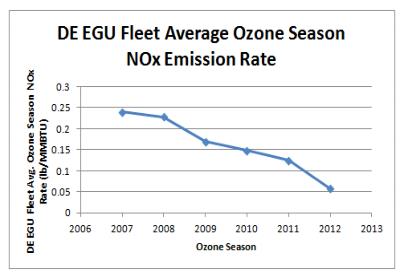
The second factor in the reduction in Delaware EGU 2007 to 2012 ozone season NOx emissions is the reduction in Delaware’s EGU fleet average NOx emissions rate. The following graph shows the reduction in Delaware’s EGU fleet average NOx emissions rate from the 2007 ozone season through the 2012 ozone season, in terms of lb/MMBTU:
The following graph shows the reduction in Delaware’s EGU fleet average NOx emissions rate from the 2007 ozone season through the 2012 ozone season, in terms of lb/MWhr:

The EPA AMPD data for the above two graphs indicate that between the 2007 ozone season and the 2012 ozone season Delaware’s EGU fleet average NOx emission rate was reduced approximately 76% in terms of lb/MMBTU, and approximately 74% in terms of lb/MWhr. This reduction in ozone season average NOx emission rate accounts for the bulk of Delaware’s ozone season NOx mass emissions reduction between the 2007 ozone season actual NOx mass emissions and the 2012 ozone season NOx mass emissions; approximately 3,080 tons. The relatively large reductions in the Delaware EGU fleet average NOx emissions rates shown in the above graphs between the 2008 and 2009 ozone seasons and the 2011 and 2012 ozone seasons correspond to the increasing stringency of the EGU NOx emissions control requirements associated with Delaware’s SIP approved regulations.
As discussed above, the actual 2012 ozone season NOx emissions are the most representative of the current Delaware NOx emissions regulation for EGUs. In order to further document the effectiveness of Delaware’s EGU NOx control regulations, a calculation was performed to estimate the Delaware EGUs’ ozone season potential to emit NOx. For this calculation, the EPA’s AMPD database was accessed for the individual Delaware EGUs to obtain the 2012 ozone season NOx mass emissions and hours of operation. The individual Delaware EGU’s ozone season hourly NOx emissions rate was determined by dividing the AMPD’s ozone season NOx mass emissions by the AMPD’s ozone season hours of operation. Each individual Delaware EGU’s ozone season potential to emit was then calculated by multiplying that EGU’s ozone season hourly NOx emissions rate by 3,672 hours per ozone season. The individual Delaware EGU ozone season potential to emit values were then added together to obtain a Delaware EGU fleet ozone season NOx emissions potential to emit. The resulting Delaware EGU fleet ozone season NOx potential to emit was 2,635 tons per season.
The above calculated Delaware EGU fleet ozone season NOx potential to emit value of 2,635 tons per season represents a reduction of 2,615 tons per ozone season (representing an approximate 49% reduction) from the NOx SIP Call EGU category allocation of 5,250 tons per ozone season for Delaware. The calculated 2,635 to per season potential to emit value also represents a reduction of 3,203 tons per ozone season (representing an approximate 55% reduction) from the NOx SIP Call’s 2007 base value 5,838 tons per ozone season for Delaware.
Of greater significance is that both the actual Delaware EGU fleet actual ozone season NOx emissions and the calculated Delaware EGU fleet ozone season potential to emit values represent ozone season NOx emissions reductions in excess of those specified in the EPA’s NOx SIP Call for the combined Delaware EGU and Non-EGU source sectors. The following table indicates the EPA’s NOx SIP Call seasonal NOx emissions reduction requirements for Delaware’s EGU and Non-EGU source sectors:

It can be seen in the above table that the NOx SIP Call’s combined NOx reduction requirement for Delaware’s EGUs and Non-EGUs was 936 tons per ozone season, relative to the 2007 base ozone season values. The actual 2012 Delaware EGU fleet ozone season NOx emissions discussed earlier in this document represents a reduction of 4,847 tons per season from the 2007 EGU ozone season base value. And also as discussed earlier in this document, the calculated Delaware EGU ozone season NOx potential to emit value of 2,635 tons per season represents a reduction of 3,203 tons per ozone season from the 2007 EGU ozone season base value.
Each of those Delaware EGU ozone season NOx emissions reductions are in excess of the total EPA’s NOx SIP Call NOx emissions reduction requirements for Delaware’s combined EGU and Non-EGU source sectors, by 3,911 tons per season for the actual 2012 ozone season and by 1,699 tons per season for the calculated EGU fleet ozone season potential to emit. From these values it is apparent that the ozone season NOx emission reductions from Delaware’s EGU source sector alone meet and exceed those NOx SIP Call seasonal NOx emission reduction requirements of the combined Delaware EGU and Non-EGU source sectors. Therefore, Delaware’s existing rules serving to regulate the ozone season NOx emissions from Delaware’s EGU fleet are sufficient to meet the EPA’ NOx SIP Call obligations for the State of Delaware without any need to rely upon cap-and-trade controls on Delaware’s Non-EGU source sector.
8.0 Resolution of 7 DE Admin 1139 Post-CAIR FIP
In the transition of certain NOx SIP Call requirements to CAIR, the USEPA determined that it would no longer administer the NOx SIP Call Budget Trading Program that it had put in place to support the NOx SIP Call. 40 CFR 51.121(r)(1) indicates, “Notwithstanding any provisions of paragraph (p) of this section, subparts A through I of part 96 of this chapter, and any State’s SIP to the contrary, the Administrator will not carry out any of the functions set forth for the Administrator in subparts A through I of part 96 of this chapter, or in any emissions trading program in a State’s SIP approved under paragraph (p) of this section, with regard to any ozone season that occurs after September 30, 2008.”
Delaware’s 7 DE Admin. Code 1139 was specifically promulgated to implement the provisions of the USEPA’s NOx SIP Call and facilitate the participation of the subject sources in the USEPA’s NOx SIP Call Budget Trading Program. As the USEPA determined that it would not administer the NOx SIP Call Budget Trading Program after the 2008 ozone season, the sources subject to Delaware’s 7 DE Admin. Code 1139 can no longer report ozone season emissions or trade allowances to meet the requirements of Delaware’s 7 DE Admin. Code 1139. Therefore sources subject to 7 DE Admin. Code 1139 cannot comply with the requirements of 7 DE Admin. Code 1139 and the regulation must be sunset.
In 40 CFR 51.121(r)(2) the USEPA indicates, “Except as provided in 51.123(bb), a State whose SIP is approved as meeting the requirements of this section and that includes an emission trading program approved under paragraph (p) of this section must revise the SIP to adopt control measures that satisfy the same portion of the State’s NOx reduction requirements under this section as the State projected such emissions trading program would satisfy.”
As discussed earlier in this document, Delaware has promulgated a series of regulations that have stringently controlled the NOx emissions from EGUs and non-EGU point sources located in the State of Delaware. Those regulations included the following:
|
•
|
7 DE Admin. Code 1112, Control of Nitrogen Oxides Emissions, effective November 1993
|
|
•
|
7 DE Admin. Code 1120, New Source Performance Standards, effective December 1988
|
|
•
|
7 DE Admin. Code 1125, Requirements for Preconstruction Review, effective August 2005
|
|
•
|
7 DE Admin. Code 1136, Acid Rain Program, effective September 1996
|
|
•
|
7 DE Admin. Code 1142, Section 1, Control of NOx Emissions from Industrial Boilers, effective December 2001
|
|
•
|
7 DE Admin. Code 1142, Section 2, Control of NOx Emissions from Industrial Boilers and Process Heaters at Petroleum Refineries, effective July 2007
|
|
•
|
7 DE Admin. Code 1144, Control of Stationary Generator Emissions, effective January 2006
|
|
•
|
7 DE Admin. Code 1146, Electric Generating Unit (EGU) Multi-Pollutant Regulation, effective January 2007
|
|
•
|
7 DE Admin. Code 1148, Control of Stationary Combustion Turbine Electric Generating Unit Emissions, effective July 2007
|
Additionally, Delaware’s air permitting regulations (7 DE Admin. Code 1102, Permits and 7 DE Admin. Code 1130, Title V State Operating Permit Program) and Delaware state law (7 Del.C., Chapter 60) provide Delaware’s Secretary of the Department of Natural Resources and Environmental Control (DNREC) with the authority to take enforcement action, and to issue orders to any person violating any rule, regulation, or order or permit condition or provision of the statue to cease and desist from such violation.
Delaware’s existing rules and regulations, identified above, have resulted in significant ozone season NOx reductions from Delaware’s fleet of EGUs. As discussed in Section 7.0 of this document, the EGU ozone season NOx emissions were conservatively estimated on a potential to emit basis at 2,635 tons per ozone season, which represents a reduction of 3,203 tons of NOx per ozone season below the NOx SIP Call’s 2007 EGU base value of 5,838 tons per ozone season. (The actual 2012 Delaware EGU fleet ozone season NOx emissions totaled 991 tons, which represents a 4,847 tons of NOx per ozone season reduction below the NOx SIP Call’s 2007 EGU base value.) EPA’s NOx SIP Call required a NOx reduction of 538 tons per ozone season from Delaware’s EGU sector and 348 tons per ozone season from Delaware’s non-EGU sector, for a combined EGU and non-EGU sector NOx reduction requirement of 936 tons per ozone season.
These values indicate that the ozone season NOx emissions reduction resulting from Delaware’s regulation of the EGU sector greatly exceeds the NOx SIP Call’s combined NOx emissions reductions from the EGU and non-EGU sectors. This demonstrates that the overall reductions achieved by Delaware’s regulation of the EGU source sector have exceeded the overall ozone season NOx emissions reduction requirements of the NOx SIP Call without relying on any ozone season NOx emissions reductions from non-EGUs.
9.0 Conclusion
Delaware has promulgated regulations that have resulted in significant ozone season NOx emissions reductions from both its EGU and non-EGU source sectors. This document demonstrates that the resulting ozone season NOx emissions reductions from Delaware’s EGU source sector exceed the ozone season NOx emissions reductions required by the EPA’s NOx SIP call for both the EGU and non-EGU source sectors, as identified in 40 CFR 51.121(g)(2)(ii), without relying on any ozone season NOx emissions reductions from non-EGUs. This document also demonstrates that Delaware has adopted control measures that satisfy the EGU and non-EGU point source NOx reductions and budgets previously addressed by Delaware’s 7 DE Admin. Code 1139 and participation in the NOx SIP Call emissions trading program, satisfying those requirements of 40 CFR 51.121(r)(2). Therefore, 7 DE Admin. Code 1139 will be sunset and Delaware’s obligation under 40 CFR 51.121(r)(2) will continue to be met through Delaware’s existing SIP approved regulations that serve to control ozone season NOx emissions, as described in this document.
4 DE Reg. 1019 (12/01/00)
12 DE Reg. 347 (09/01/08)
17 DE Reg. 538 (11/01/13)


 Authenticated PDF Version